Caravan towing speed limits aren’t the same everywhere in Australia. Some states set a towing-specific cap. Others simply require you to obey the posted limit and drive to the conditions. Here’s what the official sources say, in plain English.
Quick summary
| State / territory | What the sources say | Source |
|---|---|---|
| Western Australia | Maximum 100 km/h for any vehicle towing a trailer or caravan, even where the posted limit is higher. | WA Road Safety Commission; Road Traffic Code 2000, reg 13 |
| New South Wales | Posted limit applies, but if the tow vehicle’s GVM is over 4.5 t, or the combination’s GCM is over 4.5 t, you must not exceed 100 km/h. | NSW Government: towing a caravan |
| Queensland | No towing-specific cap is listed. Follow posted limits and tow smoothly for the conditions. | Queensland Government: towing |
| Victoria, SA, ACT, NT, Tasmania | NRMA’s summary says these jurisdictions don’t set a general towing-specific cap. Follow posted limits and conditions. | NRMA: towing speed limits |
For Victoria, SA, the ACT, the NT and Tasmania we’ve relied on NRMA’s summary, so confirm with that state’s road authority before you travel.
Other towing road rules worth knowing
- Following distance (WA): vehicles towing a caravan or trailer must stay at least 60 m behind heavy vehicles or other towing vehicles unless overtaking (WA Road Safety Commission).
- Towing mirrors: in WA, if your load is wider than your vehicle, you must have towing mirrors fitted (WA). Other states have similar requirements, so check yours.
- No passengers in the van: people must not ride in a caravan being towed (Queensland Government; WA).
- Rest areas: rules differ. In NSW, roadside rest areas aren’t for overnight stays (Transport for NSW), while in WA you can stay up to 24 hours at rest areas signed for 24-hour use (WA Government). See our free camping rules by state.
Just because you can doesn’t mean you should
Posted limits are a maximum, not a target. Your tyres, towbar, coupling and caravan may have their own speed ratings, and the NSW Government’s towing guidance says to always drive to the limits set by the manufacturer as well as road, traffic and weather conditions (NSW Government). Transport for NSW also notes that fuel use rises for most light vehicles when towing, particularly above 90 km/h (Transport for NSW).
If the van starts to sway
The NSW guidance advises not to brake the tow vehicle (except as a last resort). If the caravan’s brakes can be applied by themselves, apply them gently; otherwise hold a steady speed or slight acceleration until the sway stops (NSW Government). Prevention matters more: correct loading and ball weight. See our ball weight guide.
Before every trip
Run through the pre-towing checklist and confirm your weights are within limits, which matters in NSW where the 4.5 t threshold applies.
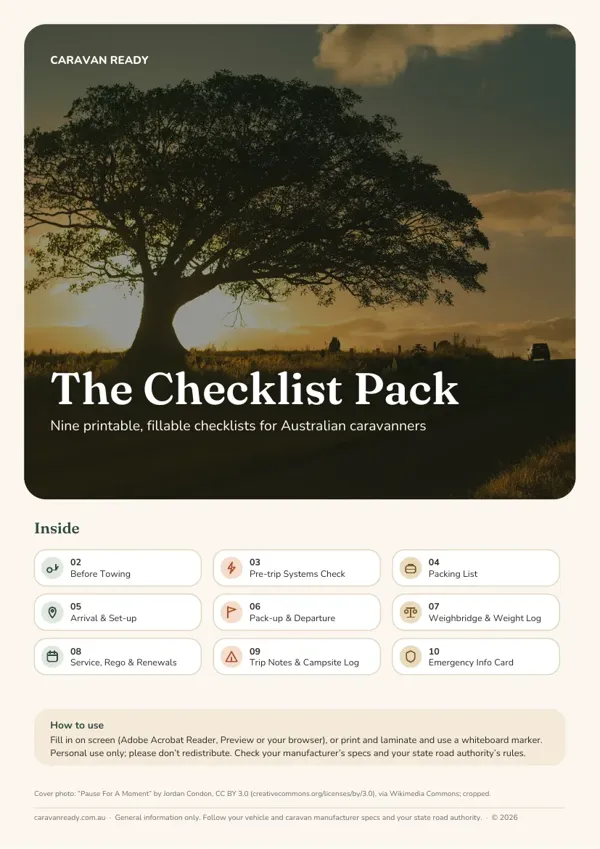
Get the Pack · AUD 7 launch price AUD 9
Nine fillable, print-friendly checklists and logs for Australian caravanners: hitch-up, packing, set-up, pack-up, weights, renewals, campsite log and an emergency card.
See what's insideTake it with you
Print the free one-page Before Towing checklist, or get the full fillable Checklist Pack.